Tennis Elbow Treatment Without Surgery: What Actually Works

If you've been dealing with persistent outer elbow pain that flares up every time you shake someone's hand, grip a coffee mug, or use a mouse, you're not imagining it, and you're certainly not alone. Tennis elbow affects roughly 1-3% of adults each year, with peak occurrence between ages 35 and 54, and it has nothing to do with whether you've ever picked up a racquet. As part of our broader guide to upper extremity conditions, this post focuses specifically on what the evidence actually says about non-surgical tennis elbow treatment, which approaches have real research behind them, how they work, and why combining multiple therapies often produces better results than relying on any single method alone.
Understanding Tennis Elbow Before You Treat It
Tennis elbow, clinically known as lateral epicondylitis, develops when the extensor tendons that attach to the bony prominence on the outside of your elbow become overloaded. Repetitive gripping, twisting, or lifting motions gradually stress the tendon attachment point, leading to micro-tears, localized inflammation, and over time, degenerative changes within the tendon tissue itself.
What makes tennis elbow treatment somewhat complicated is that the condition exists on a spectrum. Early-stage tennis elbow involves active inflammation and responds well to approaches that calm irritated tissue. Chronic tennis elbow, cases lasting longer than 3 months, often involves what researchers call tendinosis: a degenerative process where the tendon loses its normal structure. According to research published in American Family Physician, approximately 80-95% of people with lateral epicondylitis recover with conservative, non-surgical care, but treatment strategies may need to differ depending on whether the condition is acute or chronic.
This distinction matters because it shapes which tennis elbow treatment options are most appropriate at any given stage. Applying the wrong approach at the wrong time can slow recovery, which is why a thorough initial assessment is such an important starting point.
Who Gets Tennis Elbow?
Despite the name, only about 5% of tennis elbow cases actually occur in tennis players. The condition is far more common among people in occupations requiring repetitive forearm and wrist movements: painters, plumbers, carpenters, cooks, and desk workers who spend hours typing and using a mouse are all frequently affected. Studies suggest that workers who perform highly repetitive tasks or use forceful gripping motions regularly have a significantly higher incidence of developing lateral epicondylitis than the general population.
Why Rest Alone Rarely Resolves Tennis Elbow
The instinct to simply rest a painful elbow is understandable, and reducing aggravating activity is certainly a reasonable first step. But rest by itself is rarely a complete tennis elbow treatment strategy, especially for cases that have been developing for weeks or months.
Here's why: tendons have a relatively limited blood supply compared to muscles. This means they heal more slowly and respond differently to passive rest. Research on tendon biology suggests that tendons actually need appropriate loading, controlled mechanical stress, to stimulate collagen remodeling and proper tissue repair. Complete immobilization can slow this process rather than accelerate it.
That said, modifying activity is still important. The goal is to reduce the specific movements that provoke symptoms while maintaining general function and introducing therapeutic loading in a controlled, progressive way. This is where professional guidance genuinely makes a difference: identifying which activities to modify and which therapeutic exercises to introduce requires more than generic advice.
The Problem With Short-Term Pain Relief Alone
Corticosteroid injections are sometimes offered as a first-line tennis elbow treatment, and they can provide meaningful short-term pain reduction. However, several studies have found that while corticosteroid injections may outperform other approaches at 6 weeks, their advantage often disappears at 26 weeks and beyond, with some research showing higher recurrence rates compared to patients who pursued more active rehabilitation. This doesn't make injections inherently wrong, they can be a useful tool, but it does highlight why addressing the underlying tissue and movement dysfunction matters for lasting results.
Cold Laser Therapy for Tennis Elbow: What the Research Shows
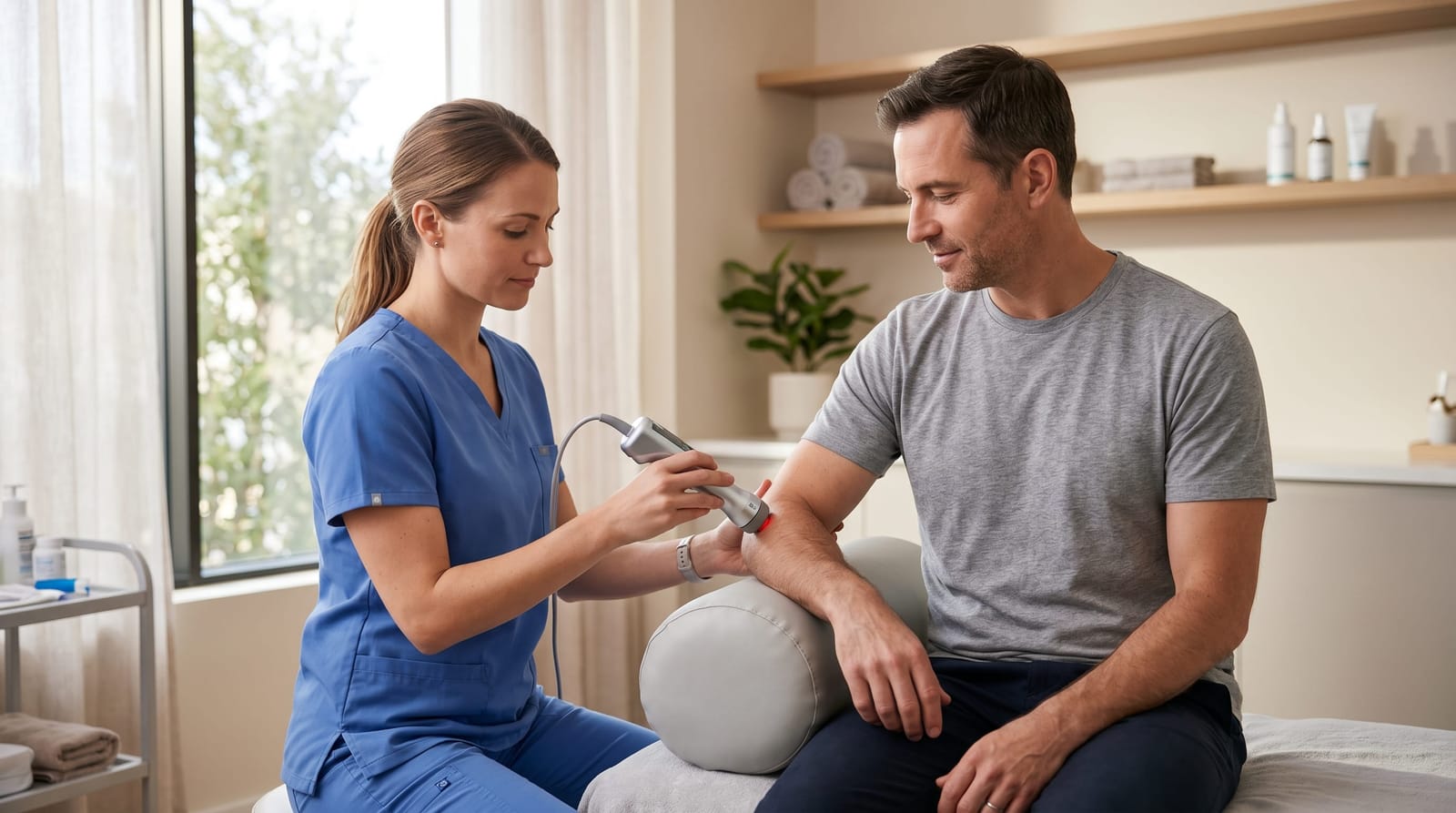
Low-level laser therapy, often called cold laser therapy or photobiomodulation, has emerged as one of the more well-supported non-surgical options for tennis elbow treatment. Unlike surgical lasers, cold laser devices use specific wavelengths of light at low power levels to penetrate tissue without generating heat, stimulating cellular energy production and tissue repair at the biological level.
A 2010 systematic review and meta-analysis published in The Lancet found that low-level laser therapy reduced pain and disability from elbow tendinopathy more effectively than placebo at short-term follow-up. Additional research has suggested that cold laser therapy may help reduce localized inflammation, accelerate tendon cell activity, and improve circulation to tissue with limited blood supply: addressing some of the core biological challenges that make tennis elbow slow to heal on its own.
In practice, patients undergoing cold laser therapy for tennis elbow typically experience a series of sessions over several weeks. Most people don't feel the laser working during treatment: it's a gentle, non-invasive process. Results tend to build progressively rather than appearing after a single session. If you're curious about the specifics of what a laser therapy course looks like, our post on cold laser treatment tennis elbow covers the session structure and what outcomes patients typically report.
Soft Tissue Therapy and Manual Treatment for Lateral Epicondylitis
One of the most clinically productive areas of non-surgical tennis elbow treatment involves hands-on soft tissue work. The forearm muscles that attach at the lateral epicondyle, particularly the extensor carpi radialis brevis, often develop areas of significant tissue restriction, trigger points, and adhesions over the course of the condition. These restrictions can affect how load is distributed through the tendon, perpetuating the cycle of irritation even when someone tries to rest.
Soft tissue mobilization techniques aim to address these restrictions directly, improving tissue extensibility, reducing localized muscle hypertonicity, and restoring more normal movement mechanics at the elbow, wrist, and forearm. Approaches such as instrument-assisted soft tissue mobilization (IASTM), myofascial release, and therapeutic massage to the forearm extensors are commonly incorporated into a comprehensive tennis elbow treatment plan.
Chiropractic Joint Mobilization and Its Role
What's sometimes overlooked in tennis elbow treatment is the role of joint mechanics, not just at the elbow itself, but along the entire kinetic chain from the neck and shoulder through the wrist. Research has indicated that cervical and thoracic spine dysfunction can influence arm pain patterns, and restrictions at the radial head (the joint on the outer elbow) can contribute to lateral epicondyle loading. Chiropractic joint mobilization targeting these areas may help reduce referred pain patterns and restore more efficient movement throughout the upper extremity. A 2009 study in the Journal of Orthopaedic & Sports Physical Therapy found that cervical and thoracic spine manipulation produced immediate improvements in pain-free grip strength in patients with lateral epicondylitis: a meaningful finding given that grip strength is one of the key functional measures in this condition.
Therapeutic Exercise: The Non-Negotiable Component
If there is one element that consistently appears in the research on effective tennis elbow treatment, it is progressive therapeutic exercise: specifically, eccentric and eccentric-concentric loading of the forearm extensors. Eccentric exercises involve controlled lengthening of a muscle under load, and this type of training has been shown to stimulate tendon remodeling and improve tensile strength over time.
A structured exercise program for tennis elbow typically progresses through several phases: early pain management and gentle range-of-motion work, introduction of isometric exercises (static muscle contractions), progression to eccentric loading, and finally, functional strengthening that mimics the demands of daily activities or sport. Studies examining exercise-based rehabilitation for lateral epicondylitis have reported clinically meaningful improvements in pain and function over 6-12 weeks of consistent participation.
The critical word here is "consistent." Therapeutic exercise for tennis elbow requires commitment beyond the clinic: home exercise programs and activity modification between sessions play a significant role in outcomes. Patients who engage actively with their exercise program tend to see better and more durable results than those who rely solely on passive treatments.
Equipment and Ergonomic Modifications
Alongside exercise, examining the mechanics of how someone performs aggravating tasks is a practical component of tennis elbow treatment that's easy to overlook. For athletes, this might mean evaluating grip size, string tension, or stroke mechanics. For office workers, it might mean adjusting keyboard height, mouse positioning, or task rotation schedules. These modifications don't replace therapeutic care, but they address the ongoing mechanical inputs that can sustain the problem: making them a meaningful part of a complete approach.
Why a Multi-Modality Approach Tends to Produce Better Results
Reading through the research on individual tennis elbow treatment methods, a consistent pattern emerges: no single intervention works optimally in isolation. Cold laser therapy supports tissue healing at the cellular level. Soft tissue work addresses muscle and fascial restrictions. Joint mobilization restores movement mechanics and may reduce referred pain. Therapeutic exercise reloads and remodels the tendon. Each approach targets a different aspect of a condition that is itself multifactorial.
This is the clinical rationale behind combining therapies rather than defaulting to a single-modality protocol. When these approaches are sequenced thoughtfully, based on where someone is in their recovery, the overall effect tends to be more comprehensive than any one method alone. A 2021 review in the Journal of Hand Therapy concluded that multimodal conservative care produced better functional outcomes for lateral epicondylitis than isolated interventions, a finding consistent with what many clinicians observe in practice.
It's also worth noting that tennis elbow treatment isn't always straightforward. If you're unsure whether what you're experiencing is lateral epicondylitis or medial epicondylitis (golfer's elbow), the two conditions require somewhat different treatment approaches: our post on tennis elbow treatment compared to golfer's elbow breaks down how a chiropractic clinic distinguishes and approaches each condition.
Related Topics Worth Exploring
Tennis elbow doesn't always exist in isolation. Shoulder mechanics, cervical spine function, and wrist mobility all influence how the elbow absorbs and distributes load. If you've been dealing with persistent upper arm or shoulder discomfort alongside elbow pain, exploring those connections can be an important part of understanding the full picture of your symptoms. Our broader upper extremity guide addresses how these areas interact and why a whole-arm perspective often matters in non-surgical care.
Taking the Next Step Toward Relief
Tennis elbow is a genuinely common and genuinely frustrating condition, but the evidence is clear that most people recover well with the right non-surgical approach. The key is matching the treatment to the stage and nature of the condition, and combining methods that address tissue healing, movement mechanics, and progressive loading together rather than in isolation.
If you've been managing elbow pain on your own and aren't seeing the progress you'd hoped for, a comprehensive evaluation can help clarify what's contributing to your symptoms and what a personalized plan might look like. At Prodigy Chiro Care, our approach to tennis elbow treatment is built around understanding the whole picture, not just where it hurts, but why. Reach out today to schedule a consultation and find out how we can support your recovery.